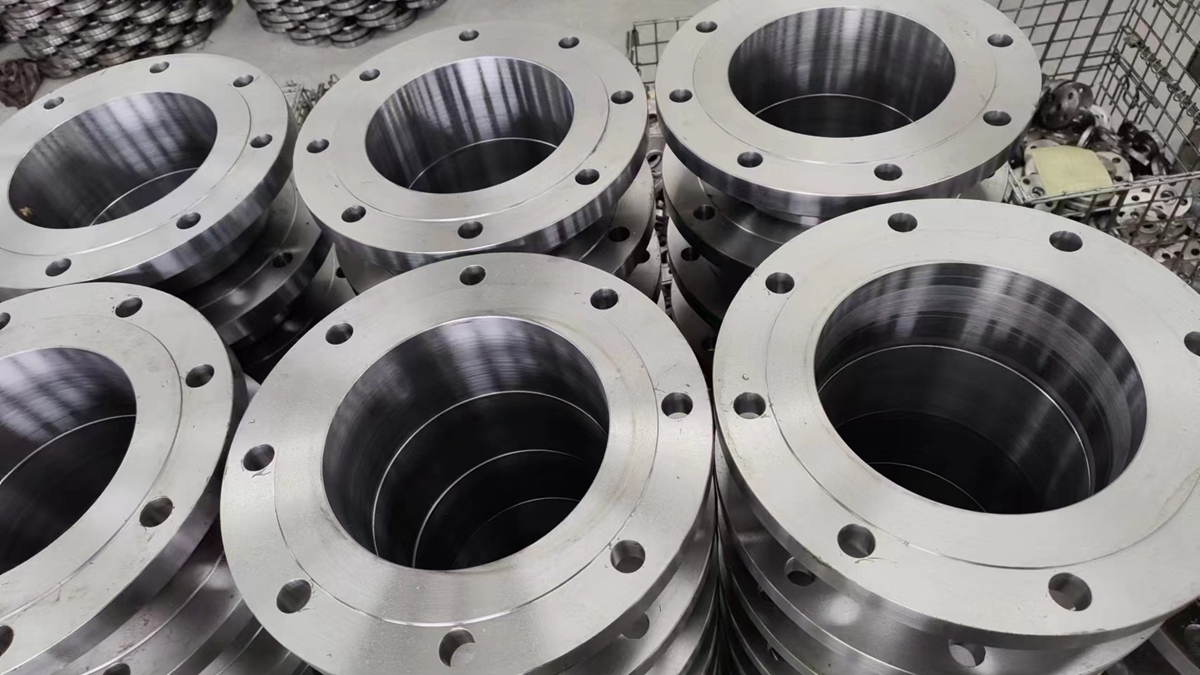
Flanges, flange connections, elbows, and stamped bends; also known as blind flanges, are flanges without holes in the middle, used to seal pipe plugs. There are various types of sealing surfaces, including flat, raised, concave-convex, tongue-and-groove, and ring joint surfaces. The sealing surfaces of flange covers include flat (FF), raised (RF), concave-convex (MFM), tongue-and-groove (TG), and ring joint (RJ) surfaces. The production materials for flange covers include carbon steel (ASTM A1, Q235, 16Mn, ASTM A350LF1, LF2CL1/CL2, LF3CL1/CL2, ASTM A694 F42, F46, F48, F50, F52, F56, F60, F65, F70);
Stainless Steel: ASTM A182 F304, 304L, F316, 316L, 1Cr18Ni9Ti, 0Cr18Ni9Ti, 321, 18-8;
Alloy Steel: ASTM A182 F1, F5a, F9, F11, F12, F22, F91, A182F12, A182F11, 16MnR, Cr5Mo, 12Cr1MoV, 15CrMo, 12Cr2Mo1, A335P22, St45.8/Ⅲ;
Pipe fitting connection
Also known as special-shaped pipe, it is a connecting accessory in pipeline installation, used for reducing diameter, branching out, changing the direction of the pipeline, and sealing the end of the pipeline.
Pipe connections mainly include threaded connections, socket connections, and electrothermal fusion welding. For flange connections, a gasket is placed between a pair of flanges fixed on two pipe ends, and then bolts are tightened to join them together, forming a detachable connection.
This type of connection is primarily used for connecting cast iron pipes, rubber-lined pipes, non-ferrous metal pipes, and flange valves. The connection between process equipment and flanges also adopts flange connection.
The main characteristics of flange connections are convenient disassembly, high strength, and good sealing performance. When installing flanges, it is required that the two flanges remain parallel, the sealing surfaces of the flanges must not be damaged, and they must be cleaned thoroughly. The gaskets used for flanges should be selected according to design specifications.
Socket connection
Socket connection is mainly used for cast iron pipes, concrete pipes, ceramic pipes, plastic pipes, etc., which have socket joints in the middle.
Socket pipes are divided into two types: rigid socket connections and flexible socket connections. In rigid socket connections, the spigot of the pipe is inserted into the bell of the pipe, aligned, and then filled with joint filler material, followed by sealing with sealing material, creating a firm and sealed connection.
The flexible socket connection joint involves placing a resilient rubber ring on the sealing end of the pipe socket, and then applying force to insert the pipe end, forming a sealed pipe that can accommodate displacement and vibration within a certain range.
Threaded connection, also known as threaded joint, connects pipes to pipes, pipes to valves, and valves to valves through internal and external threads.
This type of connection is primarily used for steel pipes, copper pipes, and high-pressure connections. Currently, threaded steel pipes are mostly threaded using thread rolling machines. However, for high-pressure pipelines that require high precision in thread machining and surface roughness, lathe machining is necessary. Blind flanges are flanges without holes in the middle, used to seal off pipe ends. There are various types of sealing surfaces, including flat, convex, concave-convex, tenon and groove, and ring joint surfaces.
A blind plate is a flange without holes in the middle, used to seal off pipe ends. There are various types of sealing surfaces, including flat, convex, concave-convex, mortise-and-tenon, and ring joint surfaces.
Loose flange plate
1. Loose flange flaps can be divided into three types: flat-welded steel ring loose flange, plate-type flange with flanging, and butt-welded ring loose flange.
2. The loose flange is a type of flange that is fitted onto the end of a pipe using flanging or steel rings, allowing the flange to move on the pipe end. The steel rings or flanges serve as the sealing surface, and the function of the flange is to press them tightly. It can be seen that due to being blocked by the steel rings or flanges, the loose flange does not come into contact with the medium.
3. Loose flange flakes are suitable for connecting steel, aluminum, and other non-ferrous metals, as well as stainless acid-resistant steel containers and corrosion-resistant pipelines. Their nominal pressure PN is 1.6 MPa.
butt welding flange
Butt-welding flange refers to a flange with a hub and a transition to a round pipe, which is connected to the pipe through butt welding.
Butt-welding flanges are suitable for pipelines with significant pressure or temperature fluctuations, or high-temperature, high-pressure, and low-temperature pipelines. They are also used in pipelines that transport expensive, flammable, and explosive media. Butt-welding flanges are resistant to deformation, have good sealing, and are widely used, with a nominal pressure PN of around 16 MPa.
Flat welding flange plate
It refers to the flange where the pipe is inserted into the inner ring of the flange for welding. Flat welding flanges are divided into two types: hubbed flat welding flanges and plate-type welding flanges.
The advantages of flat welding flanges are simple manufacturing, low cost, but the welding workload is heavy, and the consumption of welding rods is high. They cannot withstand high temperatures, high pressures, repeated bending, and temperature fluctuations, and are generally used in pipelines with PN ≤ 2.5 MPa, at room temperature, and with a working temperature t ≤ 0℃.
Suppress elbow
Press-formed elbows, also known as stamped elbows or seamless elbows, are formed by pressing excellent carbon steel, stainless steel acid-resistant steel, and low alloy steel seamless tubes in a specially designed mold.
Stamped elbow
Stamped and welded elbows are made by stamping a plate of the same material as the pipe with a stamping die to form a half-ring elbow, and then assembling and welding the two half-ring elbows together. Due to different welding standards for various pipelines, they are usually shipped as semi-finished products with points fixed by assembly, and on-site construction is carried out according to the weld grade of the pipeline. Therefore, they are also known as two-half welded elbows.
marine flange
Connection of ship flanges
Ship flanges are flanges used on ships. A flange is a component used to connect pipes to each other. It is connected to the end of the pipe. There are holes on the flange, through which bolts can be inserted to tightly connect the two flanges. A gasket is used between the flanges for sealing.
Flange connection involves securing two pipes, pipe fittings, or equipment to respective flange plates. A flange gasket is placed between the two flange plates, which are then fastened together using bolts, completing the connection. Some pipe fittings and equipment come with built-in flange plates, which also belong to flange connection.
It is a detachable connection. According to the components connected, it can be divided into vessel flanges and pipe flanges. According to the structural type, there are integral flanges, loose flanges, and threaded flanges. Common integral flanges include slip-on flanges and butt-welding flanges. Slip-on flanges have poor rigidity and are suitable for applications with pressure p≤4MPa; butt-welding flanges, also known as high-neck flanges, have greater rigidity and are suitable for applications with higher pressure and temperature.
|